Tanto per chiarire / Just to make it clear


Tanto per chiarire / Just to make it clear

Più che un blog questo è un diario di appunti, dove spesso mi segno e rilancio articoli ed opinion interessanti trovate in giro per la rete.

Cerco sempre di citare e linkare correttamente la fonte originale. Se comunque trovaste roba vostra che volete che tolga o corregga, vi prego di segnalarmelo a Stef@cutillo.eu
This is a notebook -not really a blog- where I often relaunch interesting stuff I find roaming on the net.
I always try to link correctly the original sources. If anyway you find your stuff and want me to remove or correct it, please let me know at Stef@cutillo.eu


Questo blog, ovviamente, non rappresenta una testata giornalistica in quanto viene aggiornato senza alcuna periodicità e con molta poca coerenza. Non può pertanto considerarsi un prodotto editoriale ai sensi della legge n. 62 del 7.03.2001 e seguenti.
This is just a silly legal note to state that this (SURPRISE! SURPRISE!)
is not a newspaper or a news publication whatsoever.

martedì 31 marzo 2015

Buy experiences, not things

Buy experiences, not things

by James Humblin

Forty-seven percent of the time, the average mind is wandering. It wanders about a third of the time while a person is reading, talking with other people, or taking care of children. It wanders 10 percent of the time, even, during sex. And that wandering, according to psychologist Matthew Killingsworth, is not good for well-being. A mind belongs in one place. During his training at Harvard, Killingsworth compiled those numbers and built a scientific case for every cliché about living in the moment. In a 2010 Science paper co-authored with psychology professor Daniel Gilbert, the two wrote that "a wandering mind is an unhappy mind."
Article Continues Below
Advertisement
For Killingsworth, happiness is in the content of moment-to-moment experiences. Nothing material is intrinsically valuable, except in whatever promise of happiness it carries. Satisfaction in owning a thing does not have to come during the moment it's acquired, of course. It can come as anticipation or nostalgic longing. Overall, though, the achievement of the human brain to contemplate events past and future at great, tedious length has, these psychologists believe, come at the expense of happiness. Minds tend to wander to dark, not whimsical, places. Unless that mind has something exciting to anticipate or sweet to remember.
Over the past decade, an abundance of psychology research has shown that experiences bring people more happiness than do possessions. The idea that experiential purchases are more satisfying than material purchases has long been the domain of Cornell psychology professor Thomas Gilovich. Since 2003, he has been trying to figure out exactly how and why experiential purchases are so much better than material purchases. In the journal Psychological Science last month, Gilovich and Killingsworth, along with Cornell doctoral candidate Amit Kumar, expanded on the current understanding that spending money on experiences "provide[s] more enduring happiness." They looked specifically at anticipation as a driver of that happiness; whether the benefit of spending money on an experience accrues before the purchase has been made, in addition to after. And, yes, it does.
Essentially, when you can't live in a moment, they say, it's best to live in anticipation of an experience. Experiential purchases like trips, concerts, movies, et cetera, tend to trump material purchases because the utility of buying anything really starts accruing before you buy it.
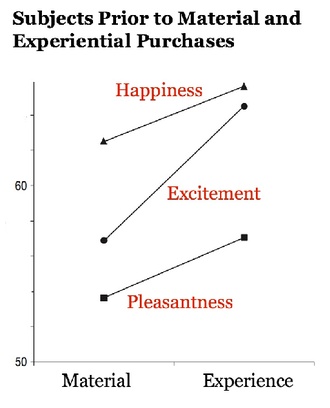
Mean self-reported ratings
(Kumar et al, Psychological Science/The Atlantic)
Waiting for an experience apparently elicits more happiness and excitement than waiting for a material good (and more "pleasantness" too—an eerie metric). By contrast, waiting for a possession is more likely fraught with impatience than anticipation. "You can think about waiting for a delicious meal at a nice restaurant or looking forward to a vacation," Kumar told me, "and how different that feels from waiting for, say, your pre-ordered iPhone to arrive. Or when the two-day shipping on Amazon Prime doesn’t seem fast enough."
Gilovich's prior work has shown that experiences tend to make people happier because they are less likely to measure the value of their experiences by comparing them to those of others. For example, Gilbert and company note in their new paper, many people are unsure if they would rather have a high salary that is lower than that of their peers, or a lower salary that is higher than that of their peers. With an experiential good like vacation, that dilemma doesn't hold. Would you rather have two weeks of vacation when your peers only get one? Or four weeks when your peers get eight? People choose four weeks with little hesitation.
Experiential purchases are also more associated with identity, connection, and social behavior. Looking back on purchases made, experiences make people happier than do possessions. It's kind of counter to the logic that if you pay for an experience, like a vacation, it will be over and gone; but if you buy a tangible thing, a couch, at least you'll have it for a long time. Actually most of us have a pretty intense capacity for tolerance, or hedonic adaptation, where we stop appreciating things to which we're constantly exposed. iPhones, clothes, couches, et cetera, just become background. They deteriorate or become obsolete. It's the fleetingness of experiential purchases that endears us to them. Either they're not around long enough to become imperfect, or they are imperfect, but our memories and stories of them get sweet with time. Even a bad experience becomes a good story.
Article Continues Below
Advertisement
When it rains through a beach vacation, as Kumar put it, "People will say, well, you know, we stayed in and we played board games and it was a great family bonding experience or something." Even if it was negative in the moment, it becomes positive after the fact. That's a lot harder to do with material purchases because they're right there in front of you. "When my Macbook has the colorful pinwheel show up," he said, "I can't say, well, at least my computer is malfunctioning!"
"At least my computer and I get to spend more time together because it's working so slowly," I offered.
"Yes, exactly."
"Maybe we should destroy our material possessions at their peak, so they will live on in an idealized state in our memories?"
"I don't know if I'd go that far," he said. "The possibility of making material purchases more experiential is sort of interesting."
That means making purchasing an experience, which is terrible marketing-speak, but in practical terms might mean buying something on a special occasion or on vacation or while wearing a truly unique hat. Or tying that purchase to subsequent social interaction. Buy this and you can talk about buying it, and people will talk about you because you have it.
"Turns out people don't like hearing about other people's possessions very much," Kumar said, "but they do like hearing about that time you saw Vampire Weekend."
I can't imagine ever wanting to hear about someone seeing Vampire Weekend, but I get the point. Reasonable people are just more likely to talk about their experiential purchases than their material purchases. It's a nidus for social connection. ("What did you do this weekend?" "Well! I'm so glad you asked ... ")
The most interesting part of the new research, to Kumar, was the part that "implies that there might be notable real-world consequences to this study." It involved analysis of news stories about people waiting in long lines to make a consumer transaction. Those waiting for experiences were in better moods than those waiting for material goods. "You read these stories about people rioting, pepper-spraying, treating each other badly when they have to wait," he said. It turns out, those sorts of stories are much more likely to occur when people are waiting to acquire a possession than an experience. When people are waiting to get concert tickets or in line at a new food truck, their moods tend to be much more positive.
"There are actually instances of positivity when people are waiting for experiences," Kumar said, like talking to other people in the concert line about what songs Vampire Weekend might play. So there is opportunity to connect with other people. "We know that social interaction is one of the most important determinants of human happiness, so if people are talking with each other, being nice to one another in the line, it's going to be a lot more pleasant experience than if they're being mean to each other which is what's (more) likely to happen when people are waiting for material goods."
Research has also found that people tend to be more generous to others when they've just thought about an experiential purchase as opposed to a material purchase. They're also more likely to pursue social activities. So, buying those plane tickets is good for society. (Of course, maximal good to society and personal happiness comes from pursuing not happiness but meaning. All of this behavioral economics-happiness research probably assumes you've already given away 99 percent of your income to things bigger than yourself, and there's just a very modest amount left to maximally utilize.)
What is it about the nature of imagining experiential purchases that's different from thinking about future material purchases? The most interesting hypothesis is that you can imagine all sort of possibilities for what an experience is going to be. "That's what's fun," Kumar said. "It could turn out a whole host of ways." With a material possession, you kind of know what you're going to get. Instead of whetting your appetite by imagining various outcomes, Kumar put it, people sort of think, Just give it to me now.
It could turn out that to get the maximum utility out of an experiential purchase, it's really best to plan far in advance. Savoring future consumption for days, weeks, years only makes the experience more valuable. It definitely trumps impulse buying, where that anticipation is completely squandered. (Never impulse-buy anything ever.)
That sort of benefit would likely be a lot stronger in an optimistic person as opposed to a pessimistic person. Some people hate surprises. Some people don't anticipate experiences because they dwell on what could—no, will—go wrong. But we needn't dwell in their heads. Everyone can decide on the right mix of material and experiential consumption to maximize their well-being. The broader implications, according to Gilovich in a press statement, are that "well-being can be advanced by providing infrastructure that affords experiences, such as parks, trails, and beaches, as much as it does material consumption." Or at least the promise of that infrastructure, so we can all look forward to using it. And when our minds wander, that's where they'll go.

martedì 24 marzo 2015

All'italiana!

Che è poi un'espressione per dire fare le cose male, a tirar via, senza lavoro di preparazione né di adattamento in opera...

La dichiarazione del ministro Poletti sulle vacanze scolastiche estive ("Troppi tre mesi di vacanze. I ragazzi dovrebbero fare lavoretti estivi") ha sollevato un vespaio di polemiche.

Giustamente!

Perché ha fatto la solita sparata improvvisata, senza ricerca né preparazione.
Non è neanche realmente una proposta: ha aperto bocca e le ha dato fiato, trasformando quella che poteva essere l'avvio di una interessante modernizzazione della scuola, in una cretinata all'italiana!

Sarebbe bastato che la pensasse un po' di più e che si informasse su come funziona altrove...


Nella gran parte dei nostri vicini europei le vacanze non sono tutte in estate, con una sola pausa a Natale. Vi sono pause in autunno e primavera e la Pasqua è un paio di settimane.

Le vacanze estive son più brevi, ma i ragazzi non arrivano stremati a fine anno. 

Ecco!
L'avesse presentata così, anziché accusare sempre qualcun altro (in questo caso i ragazzi e gli insegnanti) di essere scansafatiche...! 

giovedì 12 marzo 2015

Il giornalismo a tirar via

Che nervi il giornalismo fatto a tirar via!
È una professione splendida (e necessaria) sequestrata sempre più da inetti e propagandisti!

Leggo un articoletto del Corriere della Sera, scritto dal solito schiavo di buone intenzioni. Un giovane freelance (giovane a 31 anni???) pagato probabilmente a promesse che non verranno mantenute.

L'articolessa annunzia entusiasta la progettazione de "La prima piscina fluviale al mondo" a New York con tanto di sistema di filtraggio dell'inquinamento dell'acqua del fiume!

ooOOOHHhh!!! Direte voi!

"Prima piscina fluviale al mondo"??? mi sono chiesto invece io.
Ma se in Europa ce ne sono moltissime da anni! Ed il trend non fa che continuare! 

Ve ne sono in Francia, Belgio, Olanda, Danimarca, Germania, Svizzera... e anche in Italia, a due passi dalla Milano del Corsera. 
Ve ne sono di pubbliche e di private (alberghi, ristoranti...). 

A Berlino c'è da oltre dieci anni. Tie'! La trovi pure su Tripadvisor. 

 
Ora pensano di mettere i filtri ad un ramo intero del fiume per farne un'altra, di piscina, enorme, in pieno centro città. 
Questa è a Vienna. 

C'è a Ginevra, sul Rodano. Ed anche lei ha la forma a + (come quella progettata per New York che ha tanto entusiasmato l'articolista), visto che riprende la forma della bandiera svizzera.
È riscaldata riciclando il calore dei condizionatori dei grandi alberghi! (Parlando di soluzioni ambientaliste!) 

C'è a Parigi dal 2006. Sistemi di filtraggio simili a quelli di cui si parla per New York.  

Questa è di un albergo sul lago di Como (OK. Non è un fiume)  ed anche in Italia non è l'unica. 

La stanno per mettere anche a Praga, sempre filtrante. Sistema simile a quello della Grande Mela.

A New York non hanno inventato niente di nuovo, ma per scoprirlo bisognava cercare "piscina galleggiante" su Google! :-/ 

Peccato lavorare così!
Con una mezz'oretta di ricerca potevano impostare un'inchiesta ricca ed interessante, con esempi di esperienze diverse ed un poco di orgoglio locale. 

Altro che articoletto degno del giornaletto della scuola! Ci si potevano fare diverse pagine con foto e riquadri (e link per l'edizione online). E qualche riferimento nostrano, che accende sempre l'interesse del lettore (E magari per una volta a via Solferino -ma sono ancora lì?- avrebbero anche scucito qualcosetta). 

Invece il Corriere ha fatto la solita figura da provinciali che conoscono solo New York (per sentito dire). 
Scusate l'enfasi, ma uno si stanca!

domenica 8 marzo 2015

Buona festa del donno

Oggi chiamatemi giornalisto, papò, autisto...
Quando mi tocca il turno sarò sentinello o guardio. 
Magari vorrei anche essere considerato un bravo persono.
E no signore mie! Se ci si batte per i diritti ed il rispetto sono qui a battermi al vostro fianco.
Se ci si batte per rendere la lingua inutilmente artificiale... mi metto qui di lato e aspetterò la prossima battaglia. 

E buona festa del donno!
Ah no! Scusate.
Mi son lasciato trasportare!

mercoledì 18 febbraio 2015

Che fine ha fatto il futuro?

Da: http://www.carmillaonline.com/2015/02/15/invariant/

Ve lo ricordate il capodanno del 2000?
Era così atteso.
È arrivato.
Ed è passato
Da quindici anni.
C’è una una sola delle legittime speranze che avevamo per il 2000 che non sia stata delusa?
Non parlo di macchine volanti e colonie marziane, ma almeno di opportunità di lavoro migliori, diritti civili non condizionati dal Vaticano, un governo che non sia un monocolore democristiano che scardina e svuota la Costituzione nottetempo come un topo d’appartamento, una politica estera che non sembri una versione steampunk del colonialismo giolittiano-fascista, con le sue guerre per la Tripolitania.
Che cazzo di fine ha fatto il futuro?
Mi torna in mente il racconto “You See But You Do Not Observe” (1995) di Robert J. Sawyer, che descrive il nostro mondo come un sub-universo senza vita, un binario morto dimensionale nel quale una riscrittura del passato ha cancellato il futuro.
Niente di quello che sarebbe dovuto succedere è successo, e non solo, sono state deluse anche le aspettative più modeste.
Non credevo che saremmo stati pronti ad accogliere visitatori alieni, ma nemmeno ad annegare migranti umani pur di respingerli.
Non m’aspettavo che dal web sorgesse un’intelligenza artificiale sovrumana, ma nemmeno il twitter di Gasparri.
C’è da chiedersi se questi ultimi trent’anni siano passati davvero.
L’Ucraina dimostra come anche la celebrata fine della Guerra Fredda sia stata solo un’illusione.
Persino Philip K. Dick, col suo pessimismo profetico, se potesse vederci adesso ci direbbe “ancora così state?”
Siamo (apparentemente) da quindici anni nel terzo millennio, e la cosa più moderna che abbiamo era già stata immaginata nel 1943:
«Tirai fuori il mio comunicatore portatile, e glielo porsi. Lo osservò con crescente meraviglia, e fu deliziato quando gli mostrai il proiettore, lo stereo, e i biauricolari incorporati. Non propriamente semplice, comunque esattamente il tipo di evoluzione nel campo dell’elettronica che uno scienziato dell’epoca avrebbe associato al futuro.» Dal racconto breve di John R. Pierce ”Invariant” del 1943.
Lo scienziato in questione non sa d’essere in realtà rinchiuso in un museo, perché ha reso il suo cervello invariabile, cioè indistruttibile, ma anche incapace di registrare nuove memorie.
Incapace di ricordare il futuro.
A noi è andata anche peggio, siamo invariabili senza nemmeno essere indistruttibili. Sepolti vivi in un museo, e tenuti buoni con dei giocattoli mentre ci decomponiamo.
Dovremo incazzarci per questo, non per i lavavetri ai semafori.
Ma forse non siamo più abbastanza vivi per farlo.

mercoledì 4 febbraio 2015

Il solo futuro auspicabile


"[...] Bisogna evitare che si consolidi la percezione di una divisione tra i paesi poveri recalcitranti perché arretrati e quelli moderni e prosperi perché responsabili. 

È una percezione sbagliata, indebolisce la società e rafforza il potere dell’autorità ordoliberista.

Ora è necessario che il precariato italiano, francese, e anche (e soprattutto) tedesco emergano dal loro torpore. il punto non è chiedere una proroga nei pagamenti del debito-capestro, il punto è rovesciare il senso delle riforme, contrapporre un piano di riforma sociale al piano di riforma finanzista. [...]"

martedì 3 febbraio 2015

La religione come metafora.

La religione non dev'essere per forza la pericolosa stupidaggine che è divenuta con l'avvento delle grandi religioni monoteiste.
Può anche tornare ad essere una metafora dell'interpretazione della natura (come il dio che non giocava a dadi di Einstein) o di gestione della propria spiritualità, come per i buddisti.